A Comparative Insight into American and Korean Perm Approaches and Their Impact
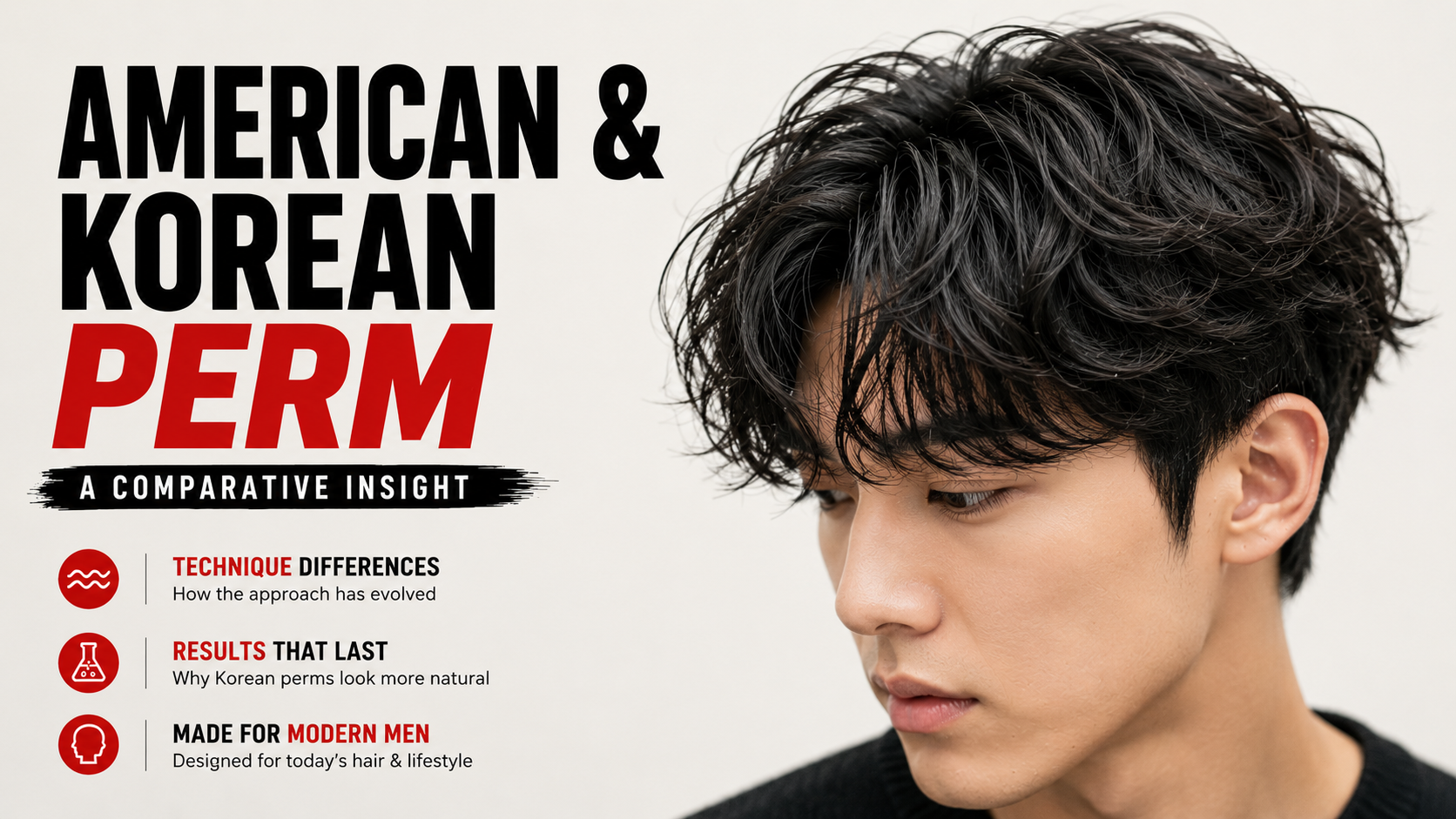
Let's be honest, when most people in the US hear the word "perm," their brain immediately goes to the 80s. Big, frizzy, spiral curls on a middle-aged woman sitting under a dome dryer. And honestly? That association has done a lot of damage. Because the perm of today, especially what's coming out of Korean barbershops and salons, looks absolutely nothing like that.
The gap between how Americans have traditionally approached perms and how Koreans have developed the technique over the last two decades is massive. And understanding that gap is actually really important if you're a guy trying to figure out why your hair never seems to do what you want it to do.
What Korea Did
Korea took a completely different road. Starting in the early 2000s and accelerating heavily through the 2010s with the global spread of K-pop and K-drama, Korean stylists were under enormous pressure to create specific, highly detailed looks , soft waves, textured volume, natural movement , on men with straight, thick, dense hair. Hair that, by nature, resists pretty much everything.
So they innovated. Korean perm haircut men techniques started being developed and refined specifically for that hair type. The digital perm, the wave perm, the body wave, the C-curl, the S-curl, the down perm, these weren't just variations on an old idea. They were genuinely new approaches, using different heat application methods, different rod placements, different chemical formulations, and a much more detailed understanding of how thick straight hair actually behaves under stress.
One of the biggest shifts was in intent. American perms were largely about curl definition. Korean perms are largely about movement and texture. The goal isn't to make your hair curly, it's to make your hair behave like it naturally has a little wave to it. Like you woke up and it just looked like that. That shift in philosophy changed everything about how the technique gets executed.
How Americans Have Historically Approached Perms
American perm culture, at its core, was built around adding volume and curl to fine, typically Caucasian hair. The chemistry was designed for that hair type, the rods, the solutions, the timing. Stylists were trained to create defined curl patterns that would hold for months.
And for a while, it worked really well for its intended audience. The problem started when that same approach got applied universally, to different hair textures, different densities, and different goals. Thick, straight, coarse Asian hair doesn't respond to a traditional American perm the same way fine hair does. The results are often unpredictable, sometimes frizzy, and rarely look like what the client asked for.
Beyond technique, there's also been a cultural angle to this. American barbering, especially men's barbering, never really embraced chemical services the way salons did. Perms were seen as a "salon thing," not a barbershop thing. So the technical knowledge within the men's grooming space stayed pretty shallow when it came to texture work.
The Technical Differences Worth Knowing
If you want to get into the actual mechanics, the digital perm, which is heavily used in Korean barbering, uses heated rods combined with a cold wave solution. The heat allows the wave to be set deeper into the hair shaft, which means the result lasts longer and looks more natural once the hair dries. Traditional cold perms set the pattern only on the surface of the hair, which is part of why they tend to look more processed.
Korean stylists also spend significantly more time on sectioning and rod selection per individual client. The size of the rod, the angle it's placed at, the tension used , all of that gets adjusted based on your specific hair thickness, your face shape, and the exact style you're going for. It's not a one-size-fits-all chemical service. It's more like a custom construction project.
The down perm is a good specific example of this philosophy in action. This technique is designed for men whose hair naturally grows outward or upward, a really common issue with thick Asian hair. The down perm doesn't add curl at all. It literally just trains the hair to fall downward and sit flat in a way that looks clean and intentional. That's a level of specificity that American grooming culture simply hasn't developed a strong tradition around.
Why This Matters for Modern Hair Aesthetics
The looks that are dominating men's hair right now , the textured fringe, the soft wave, the effortless middle part, the volume-forward styles you see everywhere from Seoul to Los Angeles , almost all of them work best when the hair has been chemically assisted in some way. Even if you can't tell.
That's the whole point. The best modern perm looks like you didn't get a perm. It looks like your hair just cooperates. And achieving that requires a stylist who understands the Korean approach to chemical texture work, not someone who's applying a 1985 playbook to a 2025 client.
Did you know one startling point is that the number of male customers who purchased hair perm products increased by 894 percent, compared to only 284 percent for female customers.
For men with straight, thick, or coarse hair, which includes a huge portion of Asian men and plenty of non-Asian men too , getting the right perm from someone who actually understands this technique can be genuinely transformative. Not in a dramatic, obvious way. In a quiet, everyday way where you spend five minutes on your hair in the morning instead of thirty, and it still looks intentional.
Why Choose Naamza
Naamza was built specifically around this gap. Founder Sehwa spent over 20 years as a barber stylist in both South Korea and the US before opening Naamza, and the entire shop was created to serve men , especially those with straight and thick hair , who kept leaving other places disappointed. Every barber on the team brings real, hands-on expertise in Korean perm techniques and modern men's cuts. You're not getting a stylist who learned perms as an afterthought.
You're getting someone who's done this specific work, on this specific hair type, hundreds of times. Both LA locations , Olympic and Vermont , offer the kind of personalized consultation that actually figures out what will work for your hair before anything touches it. No guessing. No generic formulas. Just a result that looks like it was built for you, because it was.
Ready to finally get your hair where you want it? Book your appointment at Naamza today at naamza.com and walk out looking exactly like you had in mind.
FAQs
Q: How long does a Korean perm last compared to a traditional American perm?
Ans: A Korean digital perm typically lasts anywhere from 4 to 6 months depending on your hair type and how you maintain it. Because the wave is set deeper into the hair shaft using heat, it tends to hold its shape longer and fade more naturally than a cold perm, which can start looking worn out faster.
Q: Can a Korean perm work on non-Asian hair?
Ans: Absolutely. While Korean perm techniques were developed with thick, straight hair in mind, the methods, especially digital and body wave perms , work well on a variety of hair types. The key is having a stylist who adjusts the technique to your specific texture and goal rather than applying a generic formula.
Q: Will a perm damage my hair?
Ans: Any chemical service carries some level of risk if done incorrectly or too frequently. Done well, with the right products and proper aftercare, a perm should leave your hair healthy and manageable. At a specialized shop, your stylist will assess your hair's condition first and be upfront if a chemical service isn't advisable at that time.
