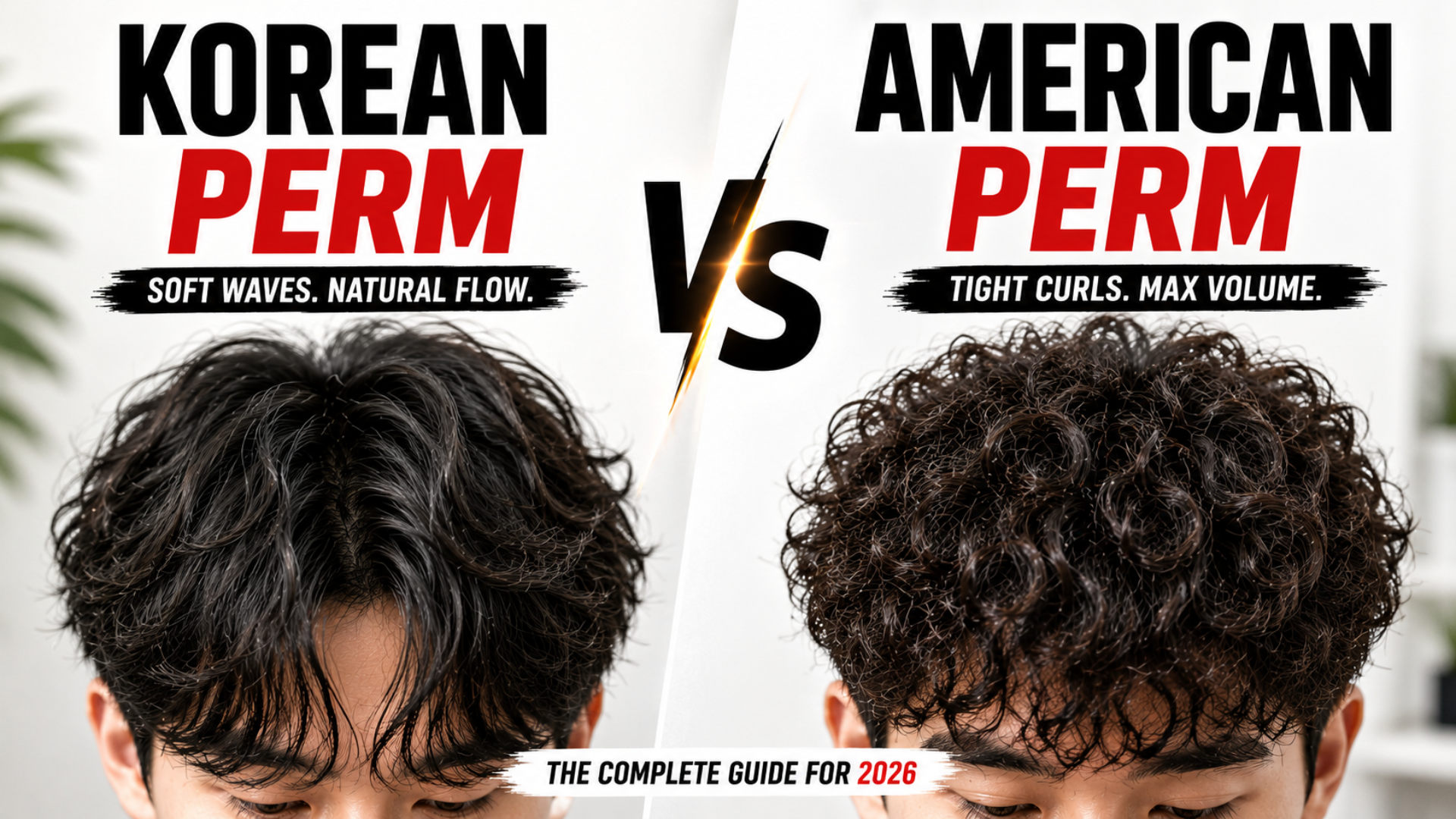
Korean Perm vs American Perm: The Complete Guide For 2026
If you've ever sat in a barber's chair trying to explain that you want "natural movement, not grandma curls," you already understand why this conversation matters. Perms have made a serious comeback, but not all perms are built the same, and confusing a Korean perm with an American perm is the kind of mistake that follows you around for the next six months.
Did you know that the global perms and relaxant market was valued at $6.384 USD Billion in 2024 and is projected to reach $8.198 billion by 2035, growing at a CAGR of 2.3%.
This guide breaks down the science, technique, and real-world outcomes of both so you can walk into a salon knowing exactly what you're asking for.
Hair Structure and Perm Chemistry: What's Actually Happening
At its core, a perm is a chemical restructuring of your hair's disulfide bonds , the cross-links within the keratin protein matrix that give your hair its natural shape. The process works in two stages: a reducing agent (typically ammonium thioglycolate or the gentler cysteamine) breaks those disulfide bonds, making the hair malleable, and then a neutralizer reoxidizes them in whatever new configuration the rod has imposed.
Both American and Korean perm Los Angeles operate on this same foundational chemistry. The divergence occurs in how chemistry is guided , the rod geometry, heat involvement, sectioning logic, and processing control. One is engineered for uniform curl formation; the other is engineered for directional flow and natural movement. That distinction shapes everything downstream.
Rod Placement and Curl Geometry
The American perm is a study in uniformity. Rods are typically consistent in size, wrapped symmetrically across the entire head, and designed to produce a predictable, repeatable curl pattern. The geometry is intentional; you get tight, defined curls with high volume distributed evenly from root to tip.
The Korean perm takes a fundamentally different approach on how the Rod works. Mixed rod sizes are used deliberately, and the wrapping direction , forward, backward, root-lifted, or angled , is mapped based on the individual's face shape, hair density, and desired styling behavior. This isn't random; it's a calculated distribution of volume and texture that allows the finished result to fall naturally without looking engineered. The output is soft waves with layered movement rather than a defined curl structure.
Heat Application and Processing Methods
This is where the two techniques diverge most sharply on a technical level. The traditional American perm is a cold process; the curl is formed entirely through the chemical reaction, with no external heat involved. It's straightforward, widely practiced, and reliable for the curl patterns it targets.
Korean perms , often referred to as digital perms or setting perms, introduce controlled heat into the equation. Infrared or digitally regulated heated rods maintain a precise temperature throughout processing, which improves curl memory and gives the wave a smoother, more natural finish. For thick, resistant hair types (which is most Asian hair), this heat-assisted processing significantly improves penetration and curl retention that a cold chemical process alone would struggle to achieve.
Sectioning and Hair Mapping
American perms follow a standard grid sectioning pattern- the head is divided into uniform sections, and the goal is full-head consistency. It's efficient and produces predictable results.
Korean perms require a considerably more involved consultation and mapping process. The stylist evaluates face shape, hair density across different zones, growth direction, and the client's intended styling routine before a single rod goes in. This customized sectioning is what allows the Korean perm to deliver targeted root volume, directional flow, and face-framing control that a grid-based approach simply cannot replicate.
Curl Pattern, Texture, and Daily Behavior
In practical terms, an American perm gives you tight curls that are voluminous, structurally defined, and largely self-sufficient. You can wake up, add some water or curl cream, and the shape is there. It's a "set and go" result that requires minimal daily intervention but also offers minimal flexibility.
A Korean perm produces loose waves, soft bends, or gentle curls that look their best with a blow dryer and a small amount of wax or styling cream. The texture is airy and touchable rather than coarse and voluminous. This also means the result is style-responsive; you can push the volume in different directions, add root lift, or let it air dry for a more relaxed look. For men, frequent trims (every 3–6 weeks) naturally reduce how long the perm appears to last
Root Volume and Directional Control
One of the most underappreciated technical advantages of the Korean perm is its root-level control. Techniques like the down perm and root perm specifically target how hair falls from the scalp, affecting face framing, parting behavior, and overall silhouette. For men with thick straight hair who want their style to sit a certain way without constant product loading, this level of directional control is genuinely difficult to replicate with any other technique.
Hair Type Compatibility and Damage Considerations
American perms perform well on fine to medium hair that holds curl readily. For thick, straight, resistant hair , the kind that tends to win every fight with a curling iron , the cold chemical process often under-delivers.
Korean perms, with their heat-assisted processing, are specifically well-suited for dense, straight hair and Asian hair types. The combination of heat and chemical action improves bond penetration and curl formation in ways that cold processing cannot match for this hair profile.
On the damage front, both methods involve meaningful chemical exposure. On shorter men’s hair, damage is less visually noticeable, but dryness and texture changes can still occur without proper aftercare. Korean perms introduce heat as an additional variable, but when administered by a skilled stylist with proper pre-treatment and bond repair systems in place, the controlled approach can actually result in better hair integrity. Post-care , bond repair treatments, hydrating masks, and sulfate-free washing matter significantly for both.
Korean Perm vs American Perm: Some More Differences
| Differences | Korean Perm | American Perm |
|---|---|---|
| Processing Time | Typically 2 to 2.5 hours due to heat regulation, sectioning precision, and multi-step application | Usually 1.5 to 2 hours since it relies purely on chemical reaction without heat management |
| Curl When Wet vs Dry | Curls activate and look best when dry and styled; appear looser and less defined when wet | Curls are most pronounced when wet and tend to loosen slightly as hair dries, the classic "wet curl" look |
| Regrowth Visibility | Grow-out is gradual and blends naturally since the wave pattern mimics natural hair movement | New growth contrast is more noticeable as straight roots against tightly curled ends creates a visible line of demarcation |
Why Choose Naamza
Naamza was built specifically around the needs of men with thick, straight, and resistant hair , the exact demographic that a standard American barbershop was never really optimized for. Founded by Sehwa, a barber stylist with over 20 years of experience across South Korea and the US, the entire service philosophy of Naamza is rooted in understanding how Asian hair behaves and how to work with its structure rather than against it.
Their team at both the Olympic and Vermont locations doesn't approach a perm as a one-size formula; they map your hair, assess your density, factor in your face shape, and design a result that makes sense for your daily life. If you've ever walked out of a salon with a perm that looked nothing like what you discussed, you already know how much that technical expertise matters.
FAQs
1. How long does a Korean perm typically last?
A Korean perm generally lasts between 2 and 3 months for men, depending on hair type, post-care routine, and how frequently you wash and heat-style. Thicker, more resistant hair tends to retain the wave pattern longer, while finer hair may see the curl relax more quickly.
2. Can I get a Korean perm if my hair has been previously colored or chemically treated?
It depends on the condition of your hair and how recently it was treated. Multiple chemical processes in close succession increase the risk of structural damage. A qualified stylist will assess your hair's integrity before proceeding and may recommend a waiting period or pre-treatment protocol.
3. What's the difference between a down perm and a regular Korean perm?
A down perm specifically targets root behavior; it's designed to make hair lie flat and fall in a controlled downward direction rather than adding volume or wave throughout the length. It's particularly popular for men who want their hair to sit naturally without looking stiff or product-heavy.
4. How should I maintain my perm in the weeks after the service?
Avoid washing your hair for at least 48 hours to allow the bonds to reform fully. After that, use sulfate-free shampoo, incorporate a moisturizing conditioner, and apply a bond-repair treatment weekly. Since men typically wash and cut their hair more frequently, consistency in light styling products becomes more important than heavy routines.
